Thursday, April 30, 2015

Religious Crossroads in the 14th Street Subway Station: A Journey Home


Throughout the course of this semester, I've gone about looking at everyday occurrences in the City under a new lens. Instead of viewing things as just casual encounters or interactions, I've begun to look into the meaning behind certain interactions in seeing how they intertwine with the works we’ve read for the course as well as how religion is present in everyday life, as subtly as it may present itself at times.

Over seven million individuals ride the subway everyday to get to and from work or wherever they may be going on a given day. Each day, numerous cultural exchanges are exhibited on the subway and it can easily be seen that the subway is perhaps one of the most diverse crossroads in New York City; no where else in NYC is there such a melting pot of cultural, religious, socioeconomic and political diversity in such close and confined quarters, all trying to arrive at the same destination.

Last week while taking the subway to 14th Street, I saw two examples of different religious perspectives before I even got to the turnstile to swipe my metrocard. First, after walking down the stairs into the entrance, there was a man hanging up different images across the walls of the platform. One in particular was the famous “coexist” poster, which was made up of different religious symbols. (I’ve included a sample of what it looked like to the left, however he preferred I didn’t take pictures of them so I obliged.)

 Upon talking to him briefly I learned that his other images were of other scientology art images, and he was an individual who practiced scientology. His purpose of being there was not to push his religious viewpoints on to others, but to expose in a broader context what scientology is in plain sense to the world around him. He further explained that he believe the subway was an important place to do this, because few other places in the city provide direct access to such a crossroads of individuals; giving him the largest network to interact with and discuss his religious experiences with individuals of different viewpoints.

As I walked away, I noticed an index card resting upon a ledge before the turnstile. Normally, I would’ve thought nothing of it but after my experience with this man, thought it might provide more input into a blog post for this class. However, to my own surprise, it was the second of three religious encounters I would have on my subway trip home.  When I approached it, I realized it was possibly one of the most well known biblical verses John 3:16 reading “For God so loved the word, that he gave his only begotten son, that so ever believeth in him should not perish but have everlasting life.”

This verse is historically known to be one of the most plain sense summations of Gods relationship with humanity on humanities quest to salvation. The two experiences connected together (the scientologist combined with the biblical verse just steps  away) provided a powerful connection to the omnipresence of religions coexisting of and by each other in the same world. Here, two different views on religion and life were being merged into one cultural experience and aided in substantiating each other.

Moreover, this relates to Leila Ahmed’s own personal journey in The Border Passage in the sense that Ahmed struggles to define her own identity through the numerous historical presences that have placed themselves on her land; creating an amalgamation and agglomeration of numerous different cultural expressions and viewpoints that have shaped the historical outlook of Islam over its history.

Furthermore, Ahmed recognizes through her journey that the future cannot be opened without an understanding of the past, and such an understanding is imperative for not repeating the mistakes of the past and being able to progress forward. Which also relates to the scientologists “coexist” message, Leila continually searches for a way to craft her own identity while letting her history coexist within the identity she is curating for herself as she progresses along her journey.

Even more fitting, as I left the 59th Street subway station to return home to Fordham, I saw a couple being approached by a Jehovah’s Witness, further exemplifying the embeddedness of religion and the diversification of humanity and our interactions with each other and specifically individuals of different backgrounds of ourselves and how we can all “coexist” with one another. So I carried on my way home, coexisting with the world around me, only now more cognizant of how our interactions all play a role in affecting each other and the history of world as time goes on.
Rosana Smith-Alvarez

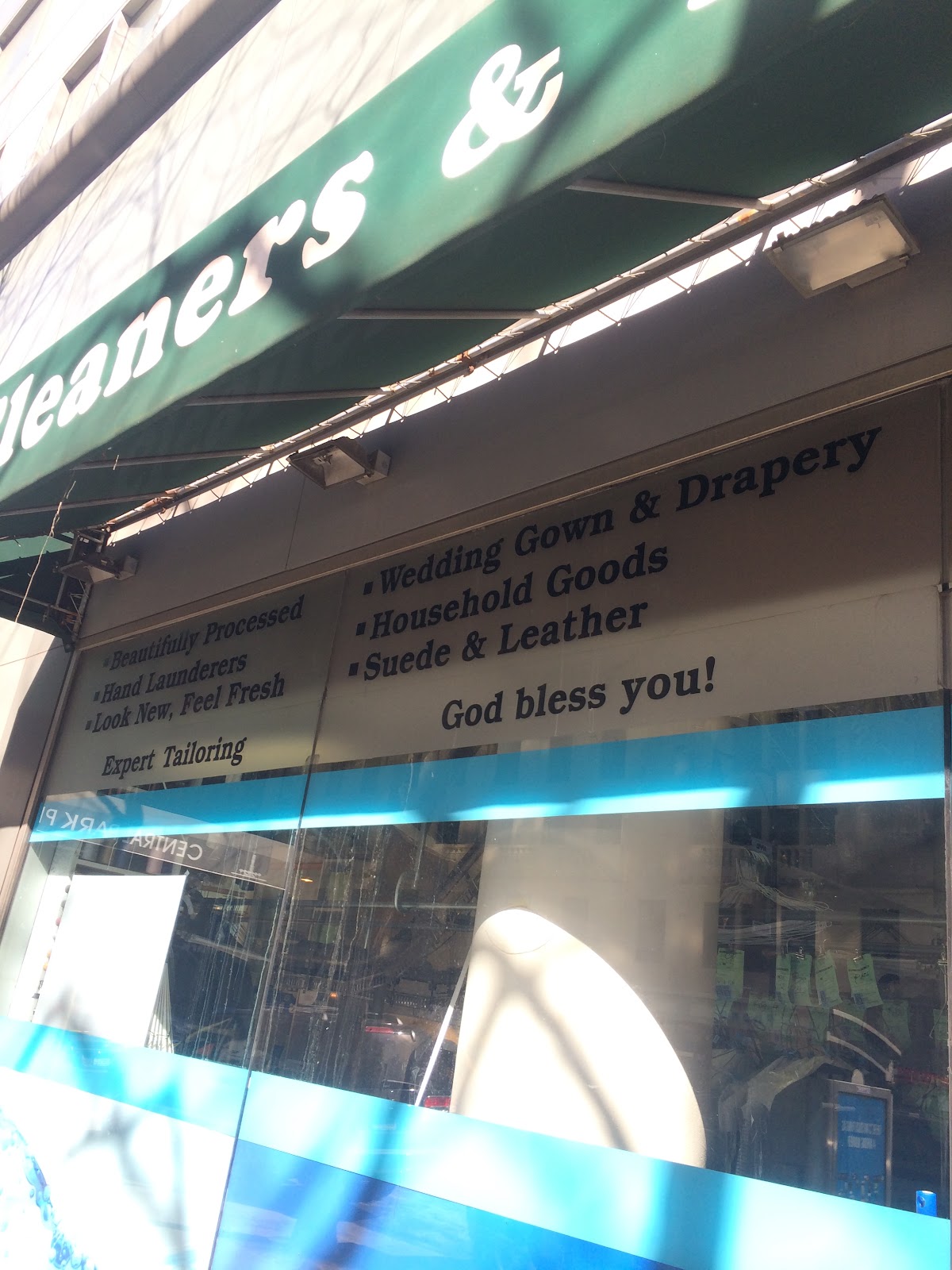
On my daily commute to Fordham, I pass by the same stores and buildings. On the block before I reach Columbus Circle, right after the Dunkin Donuts, is the Columbus Circle Dry Cleaners. I needed to get some clothes dry cleaned, so I stopped into this particular cleaners on my way to school. I received the receipt and realized that it said “God loves yout!” in large letters on the top of the ticket. I was slightly confused, considering I grew up in a certain way that made me think: how can I sell more of this or make more people want this? Don’t put religion in your advertising, because you don’t want to push anyone out or exclude anyone from even considering your product. As I left, I realized that among many bullet points on the window stating all of their products, was the sentence, “God Bless You!” At first, I figured that this is probably a family owned business that is simply religious and wants all of their customers to know it. Since then I have lost the laundry ticket, but I passed by the storefront and took a picture of the window (to the utmost surprise of the employees inside, who were staring at me with utter confusion).
Since I noticed the sign on this particular dry cleaners, I began to notice a pattern. I found two other dry cleaners that had “God Loves You!” plastered on their windows. There are various ways one can approach this as a student of American Religious Texts. Most, if not all of the employees I encountered at each store were not white Americans: they seemed to be of either Asian or Hispanic descent. From personal experience, I know that many Hispanic families, and family owned businesses, identify extremely with the Catholic Church. This may have influenced many of  the family owned businesses to spread their beliefs and extend the love onto their customers.
However, once I passed by a dry cleaners directly next to the Church of Saint Paul the Apostle, directly adjacent to fordham, I realized that this dry cleaners had the sign “God Loves You!” in the biggest lettering of all. I realized that this short sentence may not  have to do with the values of the store owners whatsoever, but could be simply a marketing stunt to attract a certain group of people. If I were going to mass every Sunday at St. Paul’s, and constantly passed by the dry cleaners with this specific message, I could be inspired by my religion and be more compelled to use their services.
This sort of “pay me, because God loves you!” idea reminded me of William James’s contemporary, Beecher, who believed that we should spend money because God wants us to be happy. In other words, since God loves us, we should treat ourselves to services that are directed toward a wealthier person, such as the luxury of having someone else do your laundry.

(pictured is the original dry cleaners that I saw)

photo.JPG

osana Smith-Alvarez

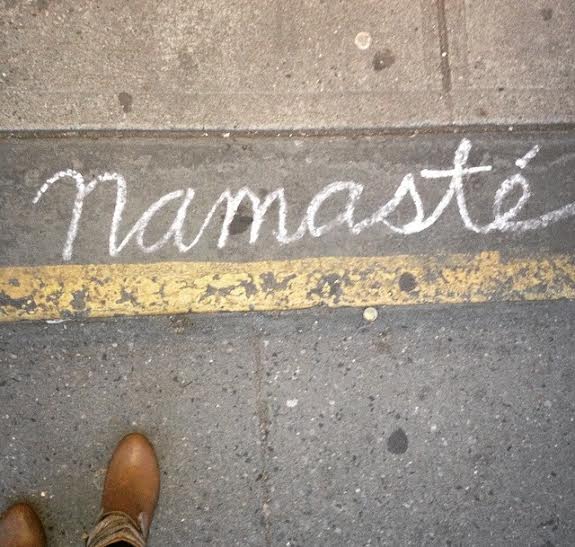
As my boyfriend, my best friend and I were walking home from my birthday brunch this past Sunday, my best friend was desperately craving some Starbucks. She had recently become a vegan, and could not have any of the coffee at the restaurant. As we were in the upper west side and still had quite a few blocks to walk, I figured we would run into one. In the next block, we did just that. On the sidewalk, just in front of the entrance to the Starbucks, was a beautifully written “Namasté”. My friend, Alexia, got excited and took a picture of it. I mentioned that it is a little bit embarrassing that I do not know exactly what “Namasté” means. She turned to me and said “Oh, me neither. We just say it at the end of yoga class.” She mentioned how it was a great “New York Find,” and how it would make a great instagram picture. She then posted it on instagram. I quickly researched exactly what Namasté is, and according to Wikipedia, it is a greeting used in Hinduism that means “I bow to the divine in you”. It is used to say hello or goodbye respectfully, and is often accompanied with a small bow. The cultural tradition originated in India.
It is impossible to know who wrote this word in chalk on the sidewalk. It could very well have been an Indian person who actively practices Hinduism and simply wants to spread their culture and positivity to any New Yorker walking down the sidewalk. It could have also very well been a white American who heard the word in yoga class and thought it was cool. The fact that the word was written in a predominantly white neighborhood, in front of a Starbucks (which is a stereotypically privileged American coffee shop). The excitement of Alexia when she saw it, and her impulse to share it on social media, shows the American obsession with “otherness” and the exotic. While this is a truly meaningful cultural and religious tradition that signifies utmost respect in Hinduism, many Americans are simply throwing the word around and using it without knowing its meaning. This is a typical example of cultural appropriation. While I understand that the intention of the project was to find meaningful religious objects in New York City, I found that this specific religious reference in the city is likely to not be legitimate.
It is also a possibility, seeing as where exactly on the sidewalk the word was written, that a starbucks employee may have written this to greet their customers. Namasté is a respectful greeting, both to say hello and goodbye. Starbucks employees are known to decorate their individual stores with handwritten chalk signs, and the handwriting on the inside of the store resembled the handwritten “Namasté” on the sidewalk. Perhaps Starbucks wants to urge people to take their money and spend it on them, because Starbucks respects its customers. Perhaps Starbucks truly wants to greet their customers with this level of respect. Perhaps Starbucks just wants to seem “cool” or “in,” in using religious signs out of context which seems to be in fashion in America today.


namaste.jpg

The Angel of the Waters

On the search for religious artifacts, I decided to start at the center of Central Park.  I was trying not to look too hard, hoping something eye-catching would appear to me.  My friend and I were happy to be strolling through Central Park on a nice Sunday afternoon with no agenda.  Walking along, we ended up stumbling onto a platform where a fountain, which I later learned is the Bethesda Fountain, sits in the center.  Despite its enormous size, I could not make out the figure on top prior to approaching closer.  I was also shocked I had never seen or heard of this fountain considering its location and beauty.  Now standing just at the edge of the water, I saw that the figure was an angel; how perfect!  Because of my lack of knowledge about where I was standing, I turned to the nearest person and asked what the fountain was called.  He informed me that we were on the Bethesda Terrace, looking at the Bethesda Fountain which contains a sculpture of the Angel of the Waters.


The essence of the statue is captured by the bible verse quoted at the statue's dedication, ”For an angel of the Lord went down at certain seasons into the pool and stirred up the water; whoever then first, after the stirring up of the water, stepped in was made well from whatever disease with which he was afflicted" (The Gospel of John 5:4),  which describes an angel blessing the Pool of Bethesda and giving it healing powers. 

I was enthralled by the beauty of the entire thing.  We stayed there for a bit longer and sat at the edge of the fountain.  I was thrilled to have found something so appropriate to the assignment, and was then excited to learn more about it.  When the day was over and I went home, I looked more into the history and making of where the fountain resides, surprised to find that this art I had never heard of was of such significance. 

In 1858, Frederick Law Olmsted and Calvert Vaux created their design of Central Park.  Central Park is “a specimen of God’s handiwork” that Olmsted said would "heal the hundreds of thousands of tired workers of their vital exhaustion, nervous irritation, and constitutional depressions.”  What Olmsted thought would affect all people of all beliefs, in God or not in God, was "a high appreciation of the city, its peoples, and a growth of brotherly feelings between diverse peoples."  When the Bethesda Fountain was completed in 1864, it added something special to the Park.  The fountain commemorates the Croton water system that first brought fresh water to New York City in 1842.  The Angel of the Waters holds a lily in her left hand, symbolizing the water's purity, important to a city that had suffered from a devastating cholera epidemic before the system was established.  The piece is the only sculpture commissioned during the original design for the Park.  Created by Emma Stebbins, it also marked the first time a woman received a public art commission in New York City.  I found that so interesting; not only does the statue hold historic religious value, but it also has significance in other realms.  Yes, the sculpture is an angel, intrinsically a religious icon, but she was placed systematically in the center of this incredible park not to remind us of God, but to bring us together.  

This was exactly what the creators of Central Park wanted.  They wanted this space to be a place of unity, an escape from the demands of reality, and a place where we can all meet to count our blessings whether it be in a religious way or not.  One does not have to have religious sentiment to appreciate the marvel of such a piece.  It was spectacular to look at, and what a sense of commonality with all the people gathered together...the way it was intended!

Kerouac, the Intangibilty of Poetry, and An Examiniation of the MTA's Infamous Heaven Poem


In looking for religious artifacts in New York, the main thing we seem to find is attempts at the miraculous or the beautiful in the mundane: the mural in a poor neighborhood, the cross on the sidewalk. It is fascinating to examine this cross-section of secularism and religion in the world around us. On a trip up to Spanish Harlem, I found some beautiful imagery: run-down churches, fruit sellers, bustling people playing great tunes outside. But it was on the subway, far Uptown, that I re-examined something I've seen a lot: the MTA's use of poetry in its subway, specifically the "Heaven" poem, written by Patrick Phillips, installed on many trains. It is a little different from something spotted on the street, but this is the first time I had really stopped to think about the poem, its connotation, its setting, and its irony.

The MTA's Poetry in Motion campaign, launched in 1992, is not by any means an awful idea. Poetry is a nice thing. Reading a poem on your commute can be wonderful; there is something inherently spiritual and intangible about poetry, the way it sits in the mind and comes off the tongue. It can make you feel alive, it can transport you, it can entertain you, it can move you. The fact that we use the word "poetic" to describe certain kinds of events or experiences or even objects is testament enough to the power of poetry. There is something truly religious about it, in that it gets at something ethereal and deep down. Kerouac and the beats were poets. They compose haikus in the mountains in The Dharma Bums. They attack the world through this lens, seeing the poetry in everything: a Mexican sunset, a breakfast of eggs.

So it's fascinating to me to see this quite beautiful art form placed in the most mundane and commonly accessed place for New Yorkers: the subway. An underground pot of stories in itself, it's full of dirt and beauty, making you simultaneously feel like a rat packed into a lab experiment and a part of the breathing organism that is New York City.  In particular, riding this train far uptown, I saw a group of kids, perhaps young high schoolers, presumably a part of some sort of program. (It was on a Sunday around 4pm and there was an advisor of sorts.) They were yelling and screaming and making jokes, and seemed to have come from one of these far uptown neighborhoods (having gotten on the train there), many of which are poorer than some of the more affluent, white neighborhoods in Manhattan. And thus there was this endlessly compelling juxtaposition, of an old, dirty train packed with people of wide varieties—homeless, kids, business people, students—who each have something to do, somewhere to be, an intent, and then a little installed poem in the corner with the title, "Heaven."

The poem itself is actually quite beautiful, but its placement is so odd. (This isn't even to mention that the poem's talk about death is unsettling when a common fear of New Yorkers seems to be getting struck by a subway.) The MTA is the bane of many New Yorkers existence, given recent price hikes and their overall attitude, but it's also how so many of the over 8 million people that live in New York City travel, and thus it takes the interesting place of an essential and necessary instutionalized evil. And so there is something off about reading a poem about heaven in what many would consider to be the complete opposite of Heaven, an underground sweaty train hurling forwards on rickety tracks. The Heaven depicted in this poem is surely a fairly secular one, and not particularly religious, but it is still Heaven: that transcendental place that is so present in every religion, not just Christianity, and is a common topic, thus, for many of our texts. I find it very interesting to examine the MTA's insertion of this poem under the lens of Kerouac, since much of his writing is so poetic, and since he and Japhy Ryder tried to achieve some sort of transcendence on this earth. (Though I don't think they would have found it in a subway car.) Kerouac's writing is a stream of consciousness "spontaneous prose" which tries to capture the immediacy of experience with complete, 100% personal honesty. His writing captures simple things—the beauty in sleeping outside—and, through his writing, captures something intangible, poetic, and spiritual.

But the MTA, a reviled company, putting a poem about heaven in the midst of the business of the subway, the travel method of the working class? It stinks of condescension. Whereas Kerouac's attempt to find a sort of heaven, or transcendence, is found in a natural and romantic enthusiasm for putting this miracle into the mundane, the MTA seems to be floating this spiritual beauty in a way that feels awkward; like a forced attempt to insert Kerouac or any poet's intangibility into the overtly tangible, a cross-point of the most explicitly non-religious (the subway car) and the spiritual (Heaven). I couldn't help thinking, watching the kids playing and laughing below the poem, that the poem felt neglected: the intangible was right there in front of me, in the beauty of human interaction. So though the poem's placement feels condescending, it is irrelevant. "Heaven" in the Subway is relegated to being put next to advertisements for Seamless and Lawyers. It's nothing more than just noise for New Yorkers.

Containing The Universe

            Finding a religious artifact in New York City is quite easy, however, for this assignment I was determined to find something that mattered to me, hence the hard part.
            On Friday night I was feeling spontaneous and was thinking of getting a new tattoo. Once in the tattoo shop I began to reconsider since coloring on yourself with permanent marker out of spontaneity can yield very poor results. There was an attractive woman getting her shoulder piece finished, so I decided to stay in the shop and look at “potential options.” Once I realized her piece was a mandala I knew it was the artifact I was searching for – also I had a great icebreaker. I asked her why she decided to get a mandala, and she told me, “It has a lot to do with maintaining balance in my life.” A very simple, yet meaningful answer.
            The mandala has become a popular tattoo choice. I had seen it before, but all I knew is that it was affiliated with Buddhism and the pattern was supposed to absorb the mind. After researching the symbol I noticed that it has been used not only in Buddhism, but Hinduism and Christianity as well. To me, it represents a bridge for Eastern and Western religions.
            Also, I learned that the geometric pattern of the mandala represents a microcosm of the universe, or in other words, seeing the same design produced in the cosmos from the macro (universal) levels all the way to the micro (meta-physical) levels. This notion dates all the way back to ancient Greece, and the way in which the mandala embodies such a profound concept amazes me. Through its complex, yet absolute, pattern the mandala causes analytical thoughts to float away. Sacred geometry has been used in various religions, because the concept is based from mathematical concepts within nature. However, I believe what the mandala encapsulates is what gives the mind comfort. The microcosm reminds us of the simplicity of an ever-expanding universe. We are comprised like everything else  this is where we belong.
            Tattoos themselves are an expression of identity and are recognized as “rebellious.” So for a woman living in a highly patriarchal society this is a method to express femininity, and someone who spends everyday confronted by the disadvantages of not being a white male should wear a symbol that holds so much power. The symmetry of the symbol is an ideal model of how gender differences should be.
            Although some people have tattoos that seem pointless, they hold a great deal of substance. It is easy to deem a “hipster” with a tattoo like a mandala as being shallow, or not being able to fathom the meaning of the symbol. But if we make fun of the people who are striving to become more spiritually diverse what does that make us? Why are white Americans allowed to have tattoos of crosses and Christian scripture, but anything else is over the line? Like Kerouac I am tired of the schism between East and West religions, especially on a symbol that has been adopted into Christianity. After our class discussion on Jerry Falwell’s Listen, America! I realized how easy it is to criticize by holding your standards to other people, but understanding people’s means cannot be done through your own lens. 

            Tattoos are a medium for expressing identity, and the amount of spiritual importance that her tattoo holds is how it matters.

Religious Conformity in the Theater District


As a self-proclaimed theater nerd, I often find myself deep in the trenches of the mid-town theater district. Even if I’m not working or seeing a show, I love being around the lights. There’s just something magical about the lights of Broadway—not too ostentatious like the giant LED screens in Times’ Square, but rather elegant in their own way.
One night, as I was walking down Forty-sixth Street, taking in the splendor of the theatre marquees, as a few new ones had just popped up, I noticed something that I had not bothered to pay attention to before. It wasn’t anything new, but it struck me in a way that I had not thought of before. I looked up to notice the shining sign of the Church of Scientology.


There’s nothing particularly special about this sign. It is plain black with white lettering and bears only name of the church on it, acting as a marker, proclaiming their location. I found it a bit strange that they even had the sign in the first place, considering the fact that their name is also on the front of the building and they have several large TV screens playing an informational video on a loop--there was no danger of mistaking the building for anything but what it is. Still, I couldn’t place why I found it to be an oddly familiar sight until I walked by Forty-fifth Street and realized why.


Every theatre on the southern side of Forty-fifth Street has a similar marquee style sign with their name on it. Of course, the Broadway signs are much flashier, their signs in color and with individual light bulbs, but the message is generally the same.


After studying their similarities, I started to think about why the church had the sign in the first place. It’s not exactly the kind of place that would want to be conspicuously advertised or necessarily draw attention to themselves, as the Church of Scientology has a reputation for being extremely secretive and selective. Furthermore, it’s located very close to the heart of Times’ Square, home to advertising and “Disneyfication” galore. Ultimately, however, I think that it is there because it helps the building blend in with its surroundings.
In comparison to their large structure in Los Angeles, this building appears incredibly modest. Of course, it is still a polished looking building, but it is definitely not something that I would expect to find in the heart of the theater district. I tried to do some research on the building itself in the hopes that it might have some sort of a theater history, as it is not unheard of to have theater spaces converted into religious space and vice-versa, but unfortunately was unable to find anything.
This got me thinking about the notion of conformity that is present throughout many of our readings. Jack Kerouac, in particular, tends to highlight and praise nonconformity. Of course, Kerouac dealt with nonconformity on a singular scale. In this case, the face of the church is conforming to its surroundings. Scientology, as a religion, is not something that the general public tends to know very much about, so people that practice it are often seen as being outsiders in terms of religious choices. In spite of this, however, the gleaming “Scientology” sign on the outside of their building seems to be an attempt at fitting in and blending with their surroundings. It is a way of conforming to the neighborhood and theater aesthetic around them, especially in regards to their location near the particularly historic Schubert Alley, located just around the corner, but still remaining firm in their societal discord. 
While the building feels a little out of place among all of the Broadway theaters, the attempt to streamline the appearance of the area is both appreciated and compelling. I hope that others who are enthused by the shining lights of the theater district are able to see this remarkable respect and observance for their location, but also recognize that a religious institution, not just a singular person, is conforming to fit the expectations around them.